
Quick answer: For a busy household, prioritize easy cleaning, a serviceable pump, clear water and battery indicators, dependable operating modes, available replacement parts, a stable drinking surface, and suitable capacity. These features reduce missed maintenance and unexpected shutdowns. Long advertised runtime is useful, but it does not replace a daily water-and-function check.
Busy pet parents do not need a fountain that promises to do everything. They need one that is easy to understand on a rushed morning, straightforward to clean, and predictable between checks.
The best choice is therefore less about the largest battery or the most modes and more about the complete routine: refill, charge, wash, reassemble, verify, and replace parts.
The Features That Matter Most
| Priority | Feature | Why it matters in a busy home |
| 1 | Easy disassembly and cleaning | Makes regular care more likely to happen on schedule |
| 2 | Clear water and battery status | Reduces surprise shutoffs and low-water operation |
| 3 | Reliable operating modes | Balances access, cat preference, and battery use |
| 4 | Serviceable pump | Allows hair and mineral buildup to be removed |
| 5 | Available filters and parts | Prevents a small consumable from sidelining the fountain |
| 6 | Stable, accessible drinking area | Helps the cat use the fountain comfortably |
| 7 | Suitable capacity | Reduces refills without encouraging stale-water habits |
| 8 | Quiet operation | Makes placement near living or sleeping areas easier |
1. Parts You Can Remove Without a Struggle
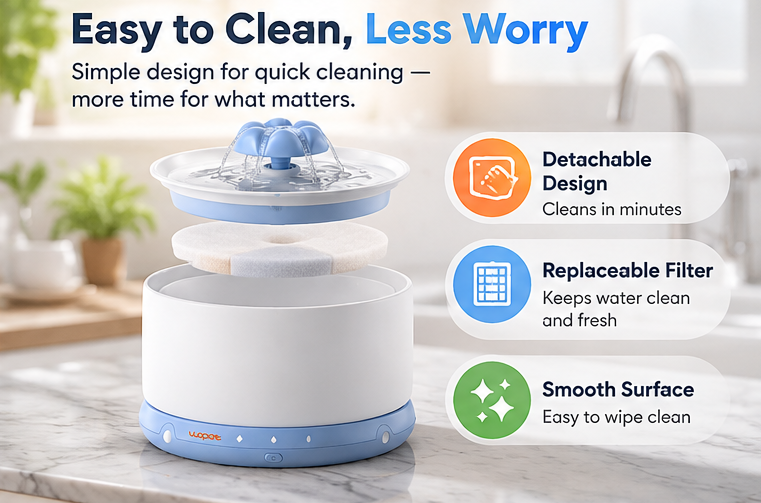
A fountain saves little time if every cleaning session becomes a puzzle. Look for a design with a removable drinking surface, accessible reservoir, clearly seated filter, and pump that can be removed without tools.
Good cleaning access matters because water touches more than the visible bowl. It also passes through the pump cover, intake, impeller chamber, filter housing, and return channel. Slime or debris can collect in those areas even when the top looks clean.
Before buying, check whether the manual shows how to:
- remove and open the pump;
- reach corners and narrow water paths;
- separate wet parts from battery or charging components;
- identify dishwasher-safe parts; and
- put the fountain back together correctly.
The WOPET W03 product information, for example, describes a removable ceramic bowl that is dishwasher safe. Model-specific instructions still determine which other parts can be washed or submerged.
2. Water-Level and Battery Indicators You Can Understand
An indicator is useful only when its meaning is clear and prompts an obvious action. A busy owner should be able to tell, at a glance, whether the fountain needs water, charging, or attention.
Look for:
- a visible minimum and maximum fill level;
- distinct low-water and low-battery signals;
- an indicator that is readable in the fountain’s intended location; and
- a manual that explains every light color or flash pattern.
Do not assume a red light means the same thing on every model. Keep the relevant manual bookmarked or stored with the fountain supplies.
3. Operating Modes That Match Real Life
More modes are not automatically better. A useful mode solves a household need.
Continuous mode
This may suit cats that prefer a steady stream, but it uses power continuously. A rechargeable fountain may need more frequent charging in this mode.
Timer or interval mode
The pump runs on a repeating schedule. This can preserve battery power while refreshing the drinking area throughout the day.
Motion or proximity mode
The pump activates when a cat approaches. It can reduce unnecessary pumping, but sensor range and placement must work for the individual cat. Test whether a cautious or slow-moving cat triggers it reliably.
Our guide to whether a wireless cat fountain can run all day explains how these modes affect all-day access.
4. A Pump You Can Maintain—and Replace
The pump is the working part most likely to show the effects of hair, mineral deposits, low water, and filter debris. Look for a design that allows the intake cover and impeller area to be cleaned according to the manual.
Also check whether a model-specific replacement pump is sold. Replaceable parts can make a fountain more practical over time than a sealed design that must be discarded when one component fails.
Do not buy a generic pump based only on similar dimensions. Voltage, connector, flow, fit, and water-path alignment must match the model. Read how long a cat fountain pump lasts before deciding whether a weak pump needs cleaning or replacement.
5. Replacement Filters That Are Easy to Identify
Filter compatibility is not universal. A listing should name the exact fountain models it fits and explain preparation and replacement.
For example, WOPET’s current ceramic fountain replacement-filter page specifies compatibility with the W03 and W03 Lite. That is more useful than choosing a filter by shape alone. Keep one unopened set on hand so the fountain does not sit unused while you wait for supplies.
The replacement schedule may change with the number of pets, debris, water conditions, and the manufacturer’s instructions. A filter also does not replace washing the reservoir or pump. For broader buying criteria, see what to look for in a rechargeable cat water fountain.
6. Capacity That Fits the Household
A larger reservoir can reduce top-ups, but capacity should not be treated as permission to ignore the water for days. Owners still need to check the level and condition daily.
Choose capacity based on:
- the number and size of pets;
- how much water remains accessible if the pump stops;
- room temperature and evaporation;
- the owner’s realistic refill routine; and
- whether the filled fountain is still easy to lift and wash.
For reference, the WOPET W03 is listed at 3 L/101 oz, while the WOPET W600 Pro is listed at 6 L and is positioned for larger dogs or multi-pet households. This is a capacity comparison, not a claim that the larger basin is automatically the better cat fountain. Material, footprint, drinking layout, and ease of cleaning still matter.
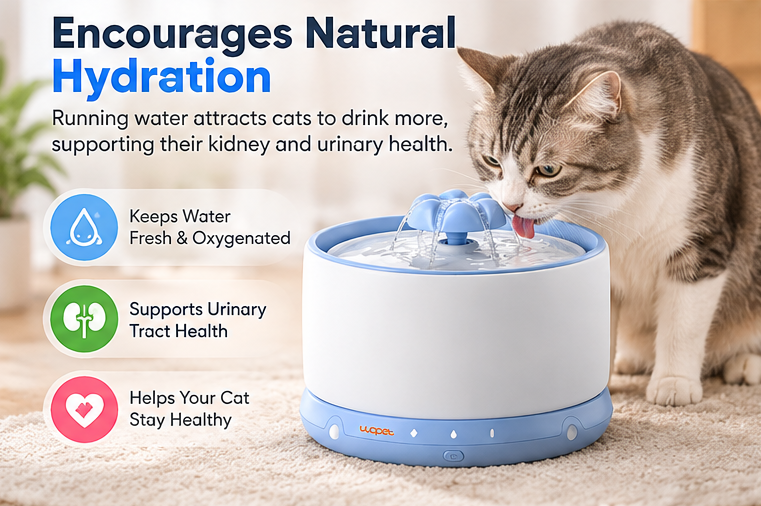
Buy WOPET W03 WIRELESS CAT FOUNTAIN ON AMAZON
7. A Stable, Cat-Friendly Drinking Area
A fountain should not slide, tip, or force an awkward drinking posture. Consider the height, width, depth, edge shape, and the amount of open space around the drinking area.
Cat Friendly Homes recommends offering fresh water in accessible locations and notes that some cats may prefer wide or shallow containers or moving water. Its guidance also advises keeping water away from litter boxes and noisy or busy areas. Read its cat water-intake guidance for placement ideas.
In a multi-cat home, one fountain may not prevent competition. Several water stations in separate locations can provide better access than one large reservoir.
8. Quiet Operation Without Vague Expectations
Pump noise can affect where a fountain fits in the home. Product pages may publish a decibel figure, but room acoustics, water level, assembly, and debris can change what owners hear.
The WOPET W03 currently lists pump noise below 25 dB, while the W600 Pro lists operation as low as 30 dB. Treat these as model-specific published specifications, not a guarantee that every setup will sound identical. A new rattle or grinding sound is a maintenance signal, not simply a personality trait of the fountain.
What a Fountain Can—and Cannot—Automate
A well-designed fountain can automate water circulation, scheduled flow, sensor activation, and certain alerts. It cannot confirm that every cat drank enough, replace old water with fresh water, wash the pump, remove biofilm, or guarantee uninterrupted access.
That distinction matters for busy owners. The best time-saving feature reduces a specific task or prevents a specific oversight; it does not make the fountain maintenance-free. A dependable routine still includes a brief daily check, scheduled cleaning, filter care, and a separate water source.
Features That Sound Convenient but Need Context
“Up to” battery runtime
An “up to” figure is useful for comparison only when the operating mode and test conditions are clear. The W03 publishes up to 30 days in timer mode with a 5,000 mAh battery. It should not be interpreted as 30 days of continuous pumping or 30 days without checking water.
App control
An app can provide alerts or history on a genuinely connected fountain, but it also adds setup, connectivity, account, and notification dependencies. Decide whether the app solves a real problem for your household. A clear physical low-water indicator may be more valuable than a crowded dashboard.
Automatic shutoff
Low-water protection can help protect the pump, but it is not a refill service. Owners still need to keep water accessible. Learn how to distinguish a protective stop from a fault in why a cat fountain keeps turning off.
Large reservoirs
More capacity can reduce top-ups, but water and wet surfaces still need routine care. A reservoir should be easy to carry, empty, and scrub when full-size cleaning day arrives.
A Five-Minute Pre-Purchase Check
Before adding a fountain to your cart, answer these questions:
- Can I find the current manual?
- Can the pump be opened and cleaned?
- Are replacement filters and pumps clearly matched to the model?
- Does the drinking area remain useful in the selected operating mode?
- Can I understand the low-water and low-battery alerts?
- Will the fountain fit where my cat already feels comfortable drinking?
- Can I realistically wash every water-contact surface?
- Is a backup bowl still part of my plan?
If several answers are unclear, a long feature list should not outweigh that uncertainty.
Where Wireless Convenience Helps Most
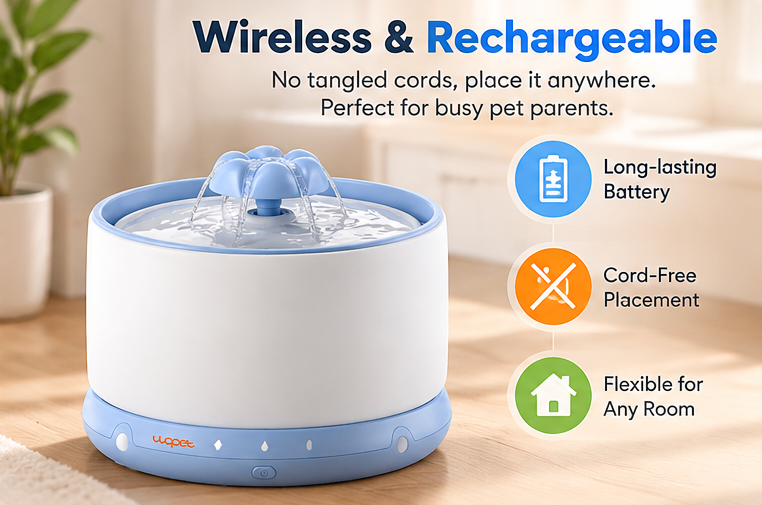
A wireless fountain is especially useful when the cat’s preferred water location has no convenient outlet, when a visible cord would cross a walkway, or when the owner wants to move the fountain between rooms.
WOPET’s pet water fountain collection currently includes rechargeable and corded designs. Compare the W03 and W600 Pro product specifications with the household’s actual routine. The best busy-owner feature is the one that removes a recurring point of failure without creating a new maintenance burden.
Frequently Asked Questions
What is the most important wireless cat fountain feature?
Easy, complete cleaning is the strongest starting point. A long battery runtime cannot compensate for a reservoir, pump, or water channel that is difficult to maintain.
Is a motion sensor worth it for a cat fountain?
It can be useful for conserving battery, provided the sensor detects your cat reliably and the placement works. Test it before depending on sensor mode as the primary water setup.
What fountain size is best for one cat?
There is no single capacity for every cat. Choose a reservoir that supports your refill schedule but remains easy to lift and wash. Check it daily regardless of size.
Do busy owners need a smart cat fountain?
Not necessarily. Smart alerts may help some households, but a dependable wireless fountain with clear physical indicators and easy maintenance may be simpler. Compare the two categories in wireless vs. smart cat fountains.
How often should fountain filters be replaced?
Follow the model-specific instructions. Pet count, debris, and water conditions can shorten the useful interval. Replace the filter sooner if it is damaged, heavily soiled, or causing restricted flow.
Choose for the Routine, Not the Feature CountThe best wireless cat water fountain for a busy pet parent is easy to check, clean, charge, and keep working. Clear indicators, dependable modes, accessible replacement parts, and a stable drinking area matter more than novelty. Choose the fountain that fits the routine you will actually follow—and keep a second fresh-water source available.