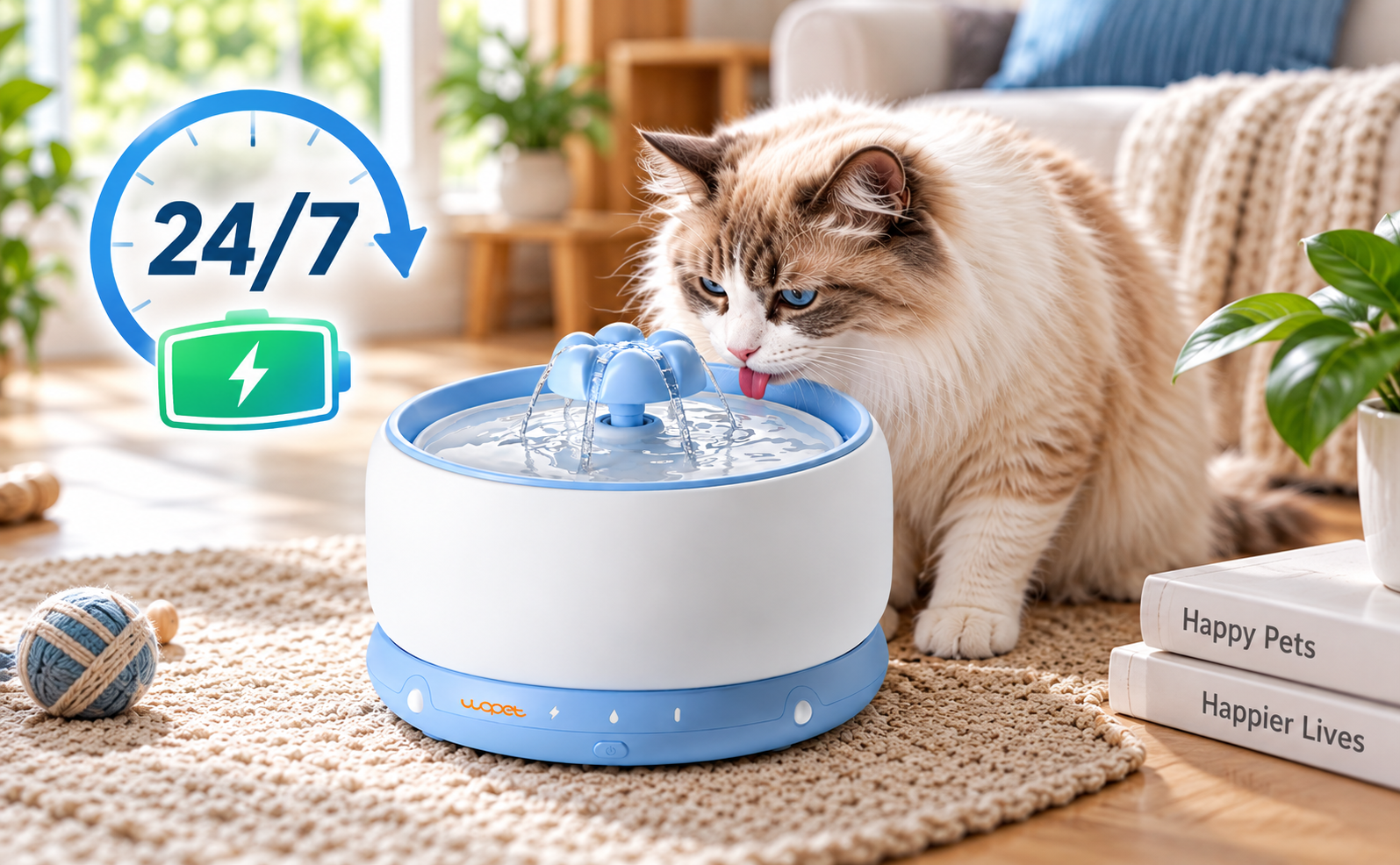

Quick answer: Yes—a wireless cat fountain can provide all-day water access when it is charged, filled, clean, and used in a manufacturer-approved mode. But all-day access does not necessarily mean 24-hour pumping. Timer and motion-sensor modes pause the pump to conserve battery. Check the fountain daily and keep a separate bowl of fresh water available in case it stops.
The right setup depends on both the fountain and the cat. A corded model may support continuous circulation, while a rechargeable model may deliver water in short cycles. Neither approach is automatically better. What matters is whether water remains accessible, the selected mode works reliably, and the owner can maintain the required refill and charging routine.
All-Day Access vs. Continuous Flow
These phrases are often treated as interchangeable, but they describe different things.
| Term | What it means | Effect on a wireless fountain |
| All-day access | Water remains available to the cat throughout the day | May be possible with continuous, timer, or sensor operation |
| Continuous flow | The pump runs without scheduled pauses | Uses battery faster and may require more frequent charging |
| Timer mode | The pump runs at set intervals | Extends runtime while refreshing the drinking surface periodically |
| Sensor mode | The pump activates when the cat approaches | Conserves power, but placement and sensor range matter |
A fountain with a filled drinking tray may still provide some water between pump cycles. Other designs depend more heavily on pump activation. Check how your specific model behaves when the pump pauses or the battery runs low.
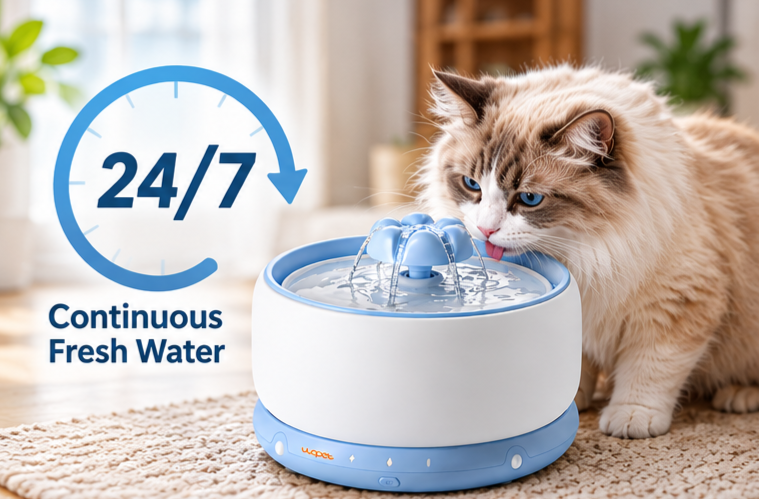
For a component-by-component explanation, read how wireless pet water fountains work.
Is It Better to Run the Pump Continuously?
Not necessarily. Continuous circulation keeps water moving, but it also draws power continuously. On a rechargeable model, that usually means a shorter interval between charges than timer or sensor mode.
Continuous flow may suit a cat that strongly prefers a steady stream and a household that can monitor the fountain and recharge it regularly. Timer or sensor mode may be more practical when flexible placement and longer battery runtime are the priorities.
The cat’s response matters more than the label on the mode. Watch whether your cat drinks comfortably, whether the sensor activates reliably, and whether water remains accessible during pauses. Do not force a nervous cat to use a fountain by removing every familiar bowl.
What Makes All-Day Operation Dependable?
1. The mode is supported by the model
Do not assume every “wireless” fountain can pump continuously. Wireless describes the power arrangement, not a standard operating schedule. Some models provide several modes; others are designed mainly for intermittent use.
Use the manual to confirm:
- which modes work on battery power;
- whether the fountain can operate while charging;
- what the indicator lights mean;
- whether water remains in the drinking area when the pump pauses; and
- how the low-water or low-battery protection behaves.
2. The reservoir stays above the minimum level
A pump needs enough water around its intake. If the level falls too low, flow can weaken, noise can increase, or a protective shutoff may stop the pump. The WOPET W03 support guidance states that this model automatically stops without water and advises keeping the level above the pump but below the maximum mark. Treat that as model-specific behavior rather than a feature shared by every fountain.
Check the reservoir daily even when its advertised capacity appears sufficient for several days. Cats drink different amounts, and evaporation, splashing, multiple pets, and warm indoor conditions can change how quickly the level falls.
3. The pump and water path are clean
Hair, food crumbs, mineral deposits, and filter debris can restrict a small pump. A partly blocked intake may still move water, but the flow can become weaker or intermittent. Cleaning the visible basin alone is not enough; the pump cover, intake, impeller area, and narrow channels also need attention according to the manual.
If the fountain becomes louder or the stream becomes uneven, turn it off and inspect it rather than letting it struggle all day. Our guide to cat fountain pump lifespan explains which symptoms suggest maintenance and which suggest replacement.
4. The battery can cover the selected schedule
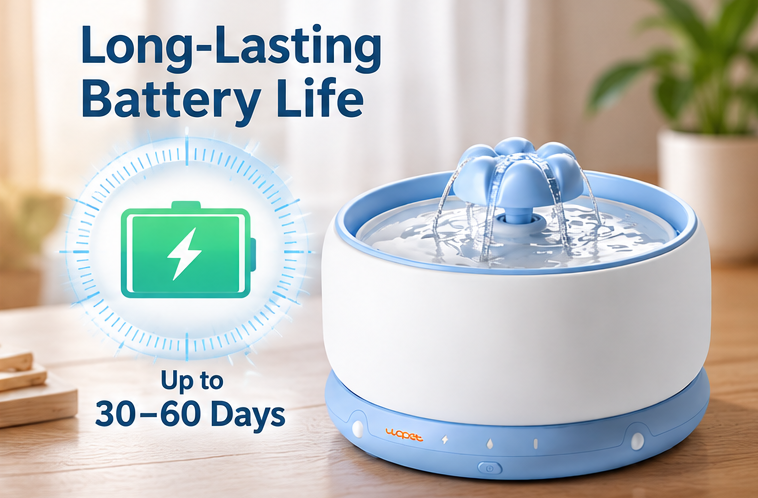
Advertised battery runtime is normally tied to particular test conditions and operating modes. The WOPET W03, for example, lists a 5,000 mAh rechargeable battery and publishes an “up to 30 days” estimate for timer mode. That figure should not be read as a promise of 30 days of nonstop pumping.
Actual runtime varies with mode, sensor activations, pump condition, water level, battery age, and other powered features. Track two or three normal charge cycles in your own home before deciding how often to recharge. See wireless cat fountain battery life for a fuller explanation.
5. The fountain is assembled correctly
Loose connections, a misaligned pump outlet, a pinched tube, or an incorrectly seated tray can interrupt flow. After cleaning, test the fountain while you are present. Confirm that water returns to the reservoir normally and does not pool near the charging port or electrical contacts.
Can You Leave a Wireless Cat Fountain on Overnight?
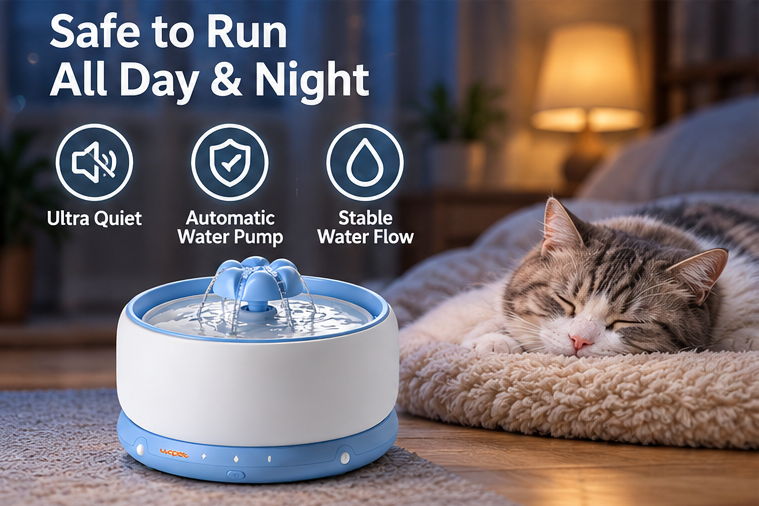
Usually, yes, when the manual permits routine operation and the fountain is charged, filled, clean, stable, and working correctly. Before bedtime, make a quick check:
- Confirm that the water is above the minimum line.
- Watch one complete flow or sensor cycle.
- Check for unusual noise, leaking, or repeated stopping.
- Make sure charging contacts and cables are dry and undamaged.
- Leave a clean backup bowl in another accessible location.
The backup bowl is important. A fountain can stop because of a depleted battery, low water, improper assembly, or a blocked pump. Redundancy is especially useful in multi-cat homes, during hot weather, or when a person will be away for several hours.
Should You Turn a Cat Fountain Off at Night?
There is no universal need to switch off a properly functioning fountain every night. Turning it off may also remove a preferred water source during hours when a cat is active. Instead, follow the manufacturer’s instructions and choose an operating mode that matches your cat’s habits.
Switch the fountain off and inspect it if:
- the pump makes grinding, rattling, or unusually loud sounds;
- water flow repeatedly starts and stops outside the selected mode;
- the reservoir is below the minimum level;
- water reaches the charging area;
- the battery housing, cable, or connector looks damaged;
- the fountain leaks or sits unevenly; or
- the water has visible debris, slime, odor, or foam.
If a fountain is behaving unpredictably, use the steps in why a cat water fountain keeps turning off before returning it to unattended use.
A Practical All-Day Routine
Every morning
- Check water level and top up with fresh drinking water if needed.
- Look for hair, food, or debris on the drinking surface.
- Confirm that the selected mode activates normally.
- Make sure the backup bowl is clean and filled.
Every evening
- Watch the flow for a few seconds.
- Check the battery indicator.
- Listen for a change in pump sound.
- Wipe up splashes around the base.
On the cleaning schedule
- Replace the water rather than only topping it off indefinitely.
- Wash all approved removable parts.
- Open and clean the pump as directed.
- Rinse or replace the correct filter on the model-specific schedule.
- Dry electrical contacts before reassembly or charging.
Cat Friendly Homes recommends providing fresh water daily, washing water containers regularly, and offering suitable water sources in accessible locations. It also notes that some cats are attracted to moving water. See its guidance on increasing a cat’s water intake.
Choosing a Fountain for All-Day Use
Look beyond the word “wireless.” Prioritize:
- a clearly documented operating mode;
- a drinking area that remains usable between cycles;
- visible low-water and battery indicators;
- a pump that can be opened for cleaning;
- replacement filters and pumps that are easy to identify;
- a stable reservoir sized for the household; and
- washable parts that can be reassembled without guesswork.
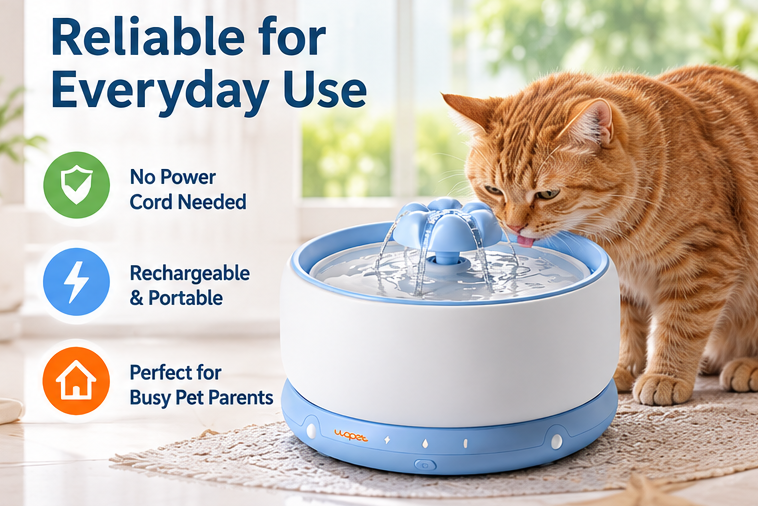
WOPET lists both rechargeable and corded models in its pet water fountain collection. A rechargeable model supports flexible placement; a corded model may be a better fit when continuous flow is the main priority. Compare the actual modes and maintenance requirements rather than choosing by power style alone.
Buy WOPET W03 BLUE WIRELESS CAT WATER FOUNTAIN ON AMAZON
Frequently Asked Questions
Can a wireless cat fountain run 24/7?
Some models support continuous flow, while others are intended to run in timed or sensor-activated cycles. Check the manual. Running a rechargeable pump continuously will normally use the battery faster than an intermittent mode.
Will turning a fountain off make the water unsafe?
A short pause does not automatically make water unsafe, but standing water still needs to be replaced and the fountain still needs regular washing. A filter does not make old water fresh indefinitely.
Does a motion-activated fountain give my cat enough access?
It can, provided the sensor detects the cat reliably and water remains accessible as designed. Test the approach angle and placement with your own cat before relying on it.
Can I leave a wireless fountain running while I am at work?
You can when the fountain is operating normally and its manual permits routine use. Fill and test it before leaving, and provide a separate bowl in case the battery, pump, or sensor stops.
Should I keep a cat fountain plugged in while it runs?
Only if the manufacturer says that model supports operation while connected to power. Keep the charging area dry and use the specified cable and power requirements.
The Bottom LineA wireless cat fountain can support all-day access without pumping nonstop. Match the operating mode to the model, your cat’s drinking behavior, and a realistic charging routine. Daily checks, correct water level, pump cleaning, and a backup bowl create a more dependable setup than switching the fountain on and assuming it will manage itself.