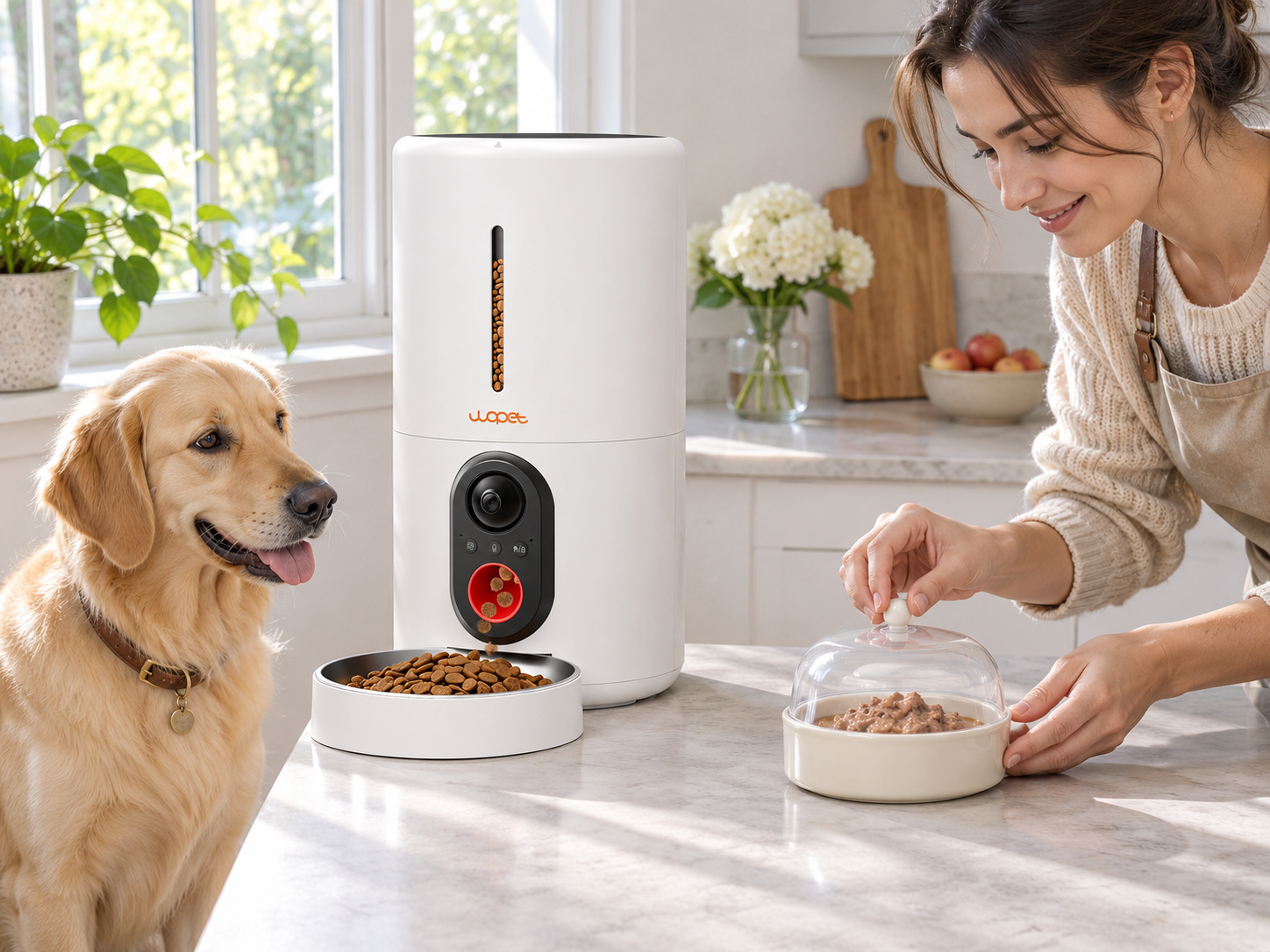


Why ordinary hopper feeders usually use dry kibble
Check the manual before putting wet food in a dry-kibble hopper. These feeders rely on food moving through a chute, and wet food can cling to the parts that dispense it.
Specialized wet-food feeders are a different category
Some timed feeders are designed around portioned wet meals and may use sealed compartments or cooling features. Their limitations are model-specific: how long a portion may remain in the unit, how cooling works, which containers fit, and how components are cleaned. Read the manual and food packaging directions together. A cooling feature does not mean food can be left indefinitely, and it does not remove the need to discard uneaten food promptly.
Treat storage and hygiene as part of the decision
Wet food needs careful handling. Keep unopened and opened food according to its package directions, use clean utensils, and wash food-contact dishes. The FDA’s safe handling guidance for pet food is a useful general reference. When in doubt about how long a particular meal may sit out, ask your veterinarian or the food manufacturer rather than relying on a general rule.
If your dog eats both wet and dry food
Some households feed wet food at one meal and use dry kibble at another. A dry-food feeder may help with the kibble portion while wet food is served fresh by a person. Keep the portions and daily total aligned with your dog’s feeding plan. Don’t mix wet food into a hopper intended for dry kibble, and don’t coat kibble with broth or toppers unless the feeder instructions allow that texture.
A practical compatibility check before buying
Look for an explicit statement that the model supports the food you intend to use. Verify whether the bowl, tray, or compartment is removable, what cleaning method is allowed, and how much food it holds. If the listing only describes dry kibble dispensing, treat it as a dry-food product. Check the included manual or contact the manufacturer before purchase if the wording is unclear.
Where WOPET products fit
The WOPET HV10P and F07 Pro are positioned as dry-food feeder options. Check their current product details and model manuals for approved food types, portion controls, and cleaning directions. If wet food is essential to your routine, compare products built specifically for it rather than trying to adapt a dry-food hopper.
Choosing a feeder for wet or dry food
Use a feeder only with the foods and cleaning routine it was designed to support. A timed device can make dry kibble meals more consistent, while wet food generally needs more direct attention to storage and leftovers. For capacity, schedule, and other selection criteria, see our guide to choosing an automatic dog feeder. The right setup is the one that fits the food, preserves hygiene, and still leaves a person responsible for checking the dog.
Wet food, treats, and mixed meals
Some owners use a wet meal for one feeding and dry kibble for another. That arrangement can work only when each food is stored and served as directed. Do not use a hopper for treats or toppers unless the model explicitly supports them; small, sticky, or irregular pieces can behave differently from kibble. If the dog has a special diet, ask the veterinary team how to preserve the prescribed amounts when one part is hand-served and another is automated.
Questions to ask before choosing a specialized wet feeder
Ask how long a portion can remain in each compartment, whether the unit actively cools the food or simply covers it, which containers are washable, and how to clean seals or hinges. Confirm whether the unit uses power and what happens if it fails. Look for clear capacity and food-safety instructions from the manufacturer. If those details are missing, contact the seller before purchase rather than relying on reviews that may refer to a different model.
Why retrofitting a kibble feeder is a poor shortcut
Placing canned food in a dry-food hopper can coat components and create a cleanup problem the device was not designed for. A moist texture might not pass through the dispenser consistently and could be difficult to remove from narrow internal areas. Similarly, adding water to kibble can change how it flows and how quickly it should be consumed. Keep the appliance within its described use and avoid modifying the mechanism.
Transitioning to a new serving method
When introducing a wet-food feeder or changing meal delivery, supervise early meals. Confirm the dog eats from the new dish, that portions are correct, and that leftovers are handled safely. Maintain the same total ration unless a veterinarian recommends a change. If the dog refuses food or has symptoms after a diet change, contact a veterinary professional. A convenient feeding device should make the existing plan easier, not complicate food safety.
How to read product descriptions carefully
Product listings sometimes use broad terms such as ‘automatic’ without spelling out compatible food. Look for explicit instructions about dry kibble, wet food, fresh food, tray compartments, refrigeration, and washable components. If the manufacturer’s language is ambiguous, ask customer support for a written answer tied to the exact model. Check whether the cleaning process requires removing a tray after every use, as that affects whether the device is realistic for your schedule. Product photos alone cannot establish food compatibility or safe holding time.
A quick pre-purchase checklist for wet feeding
Before ordering, write down the food brand and texture you use, the meal size, and how long the meal would wait before the dog eats. Match those details to the product’s explicit instructions. Confirm the feeder can keep the portion in the required conditions and that its tray can be cleaned thoroughly. If the device is for occasional use, consider whether the extra setup and cleaning are still worthwhile. The cheapest or most feature-rich model is not necessarily the one that fits the real feeding routine.