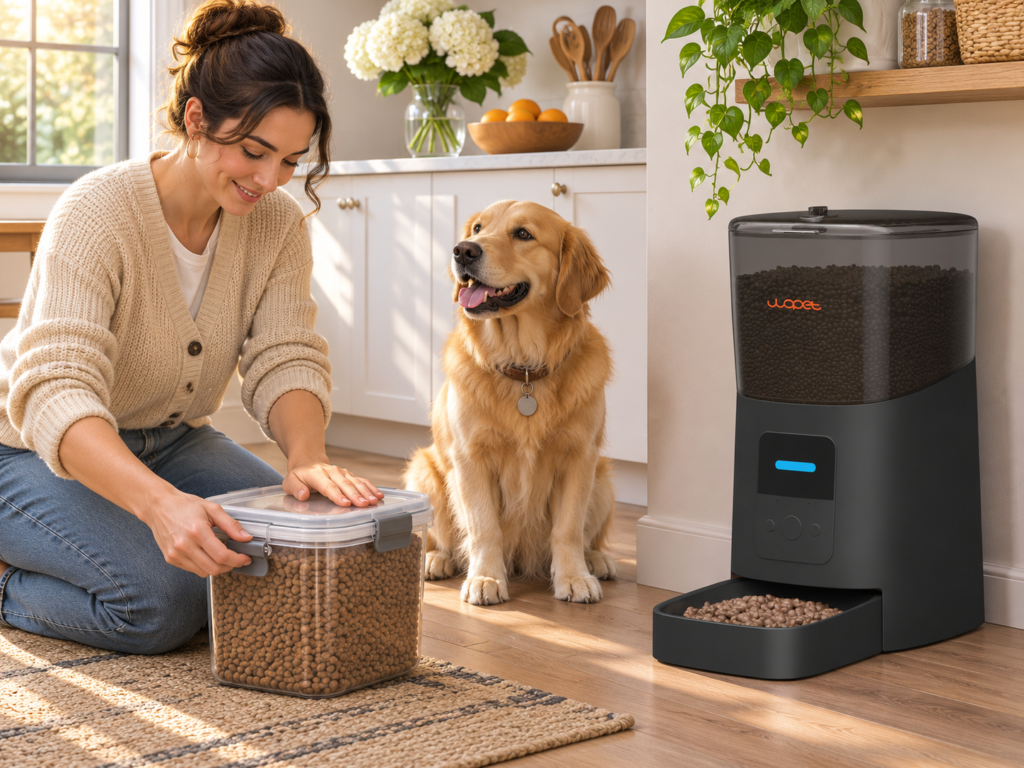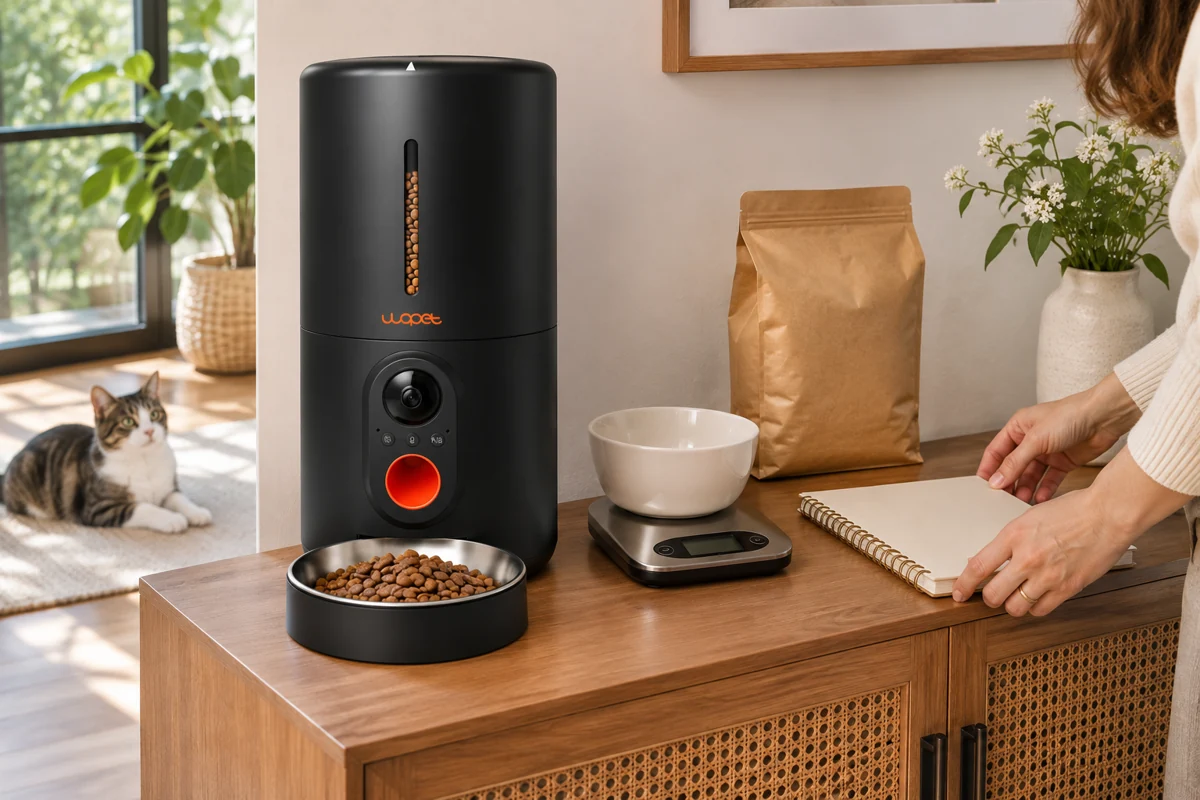

Write down when your dog eats and weigh a usual meal. Those measurements tell you more about which feeder will fit your routine than the hopper size alone.
Start with your dog’s real feeding routine
Write down when your dog currently eats, how much food is offered across the day, and who usually handles meals. Note any constraints too: an early work start, different weekday and weekend schedules, or a dog who needs meals separated from another pet. A feeder is most useful when it supports a routine you and your veterinarian have already chosen.
Meal frequency and daily food amount are individual. Age, body condition, activity, health, and the food’s calorie density can all matter. The American Kennel Club’s overview of how often dogs eat and its guide to how much to feed a dog are useful starting points; use your dog’s food label and veterinarian’s advice for the actual plan.
Check food compatibility before comparing features
Most timed hopper feeders are designed for dry food. Before buying, check the exact model’s manual for the permitted kibble size and food type. Large, irregular, sticky, or moist pieces may not move through a dry-food mechanism as intended. If your dog eats a specialized diet, confirm compatibility with the manufacturer and your veterinarian rather than assuming a standard feeder will handle it.
Capacity is storage volume, not a promise that food will stay fresh for a particular number of days. Choose a hopper that suits your refill habits, keep the food in line with its packaging instructions, and clean food-contact parts as the manual directs.
Treat portion settings as a starting point
A feeder’s portion unit is a device setting. It does not automatically equal a fixed number of grams for every kibble. Shape, size, and density can change how much falls into the bowl. When setting up a new feeder, dispense several test servings of your dog’s usual food into a separate container and weigh them. Repeat the check so you understand the range, then adjust the schedule with your veterinarian’s feeding guidance in mind.
Keep a short record of the meal time, selected portion, and measured output. If you change foods, repeat the check. For more detail, see our portion-measuring walkthrough; its weighing method is useful, but always follow the instructions for the specific dog-feeder model and food you use.
Decide whether app control or a camera matters to you
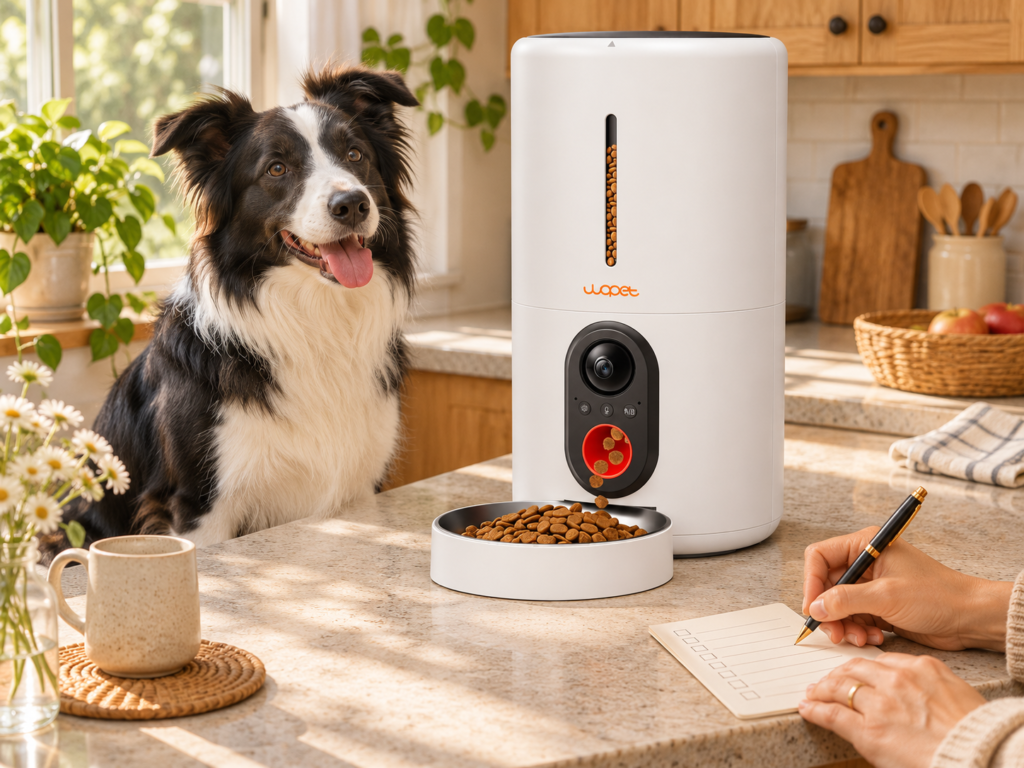
A basic timed feeder may be enough if you mainly want meals dispensed on a schedule. App-connected models can be useful when you want to adjust a schedule remotely or check the feeder’s status. A camera can let you see whether your dog came to the bowl, but it cannot replace a person checking on the dog, and a video connection is not the same as confirming how much food was eaten.
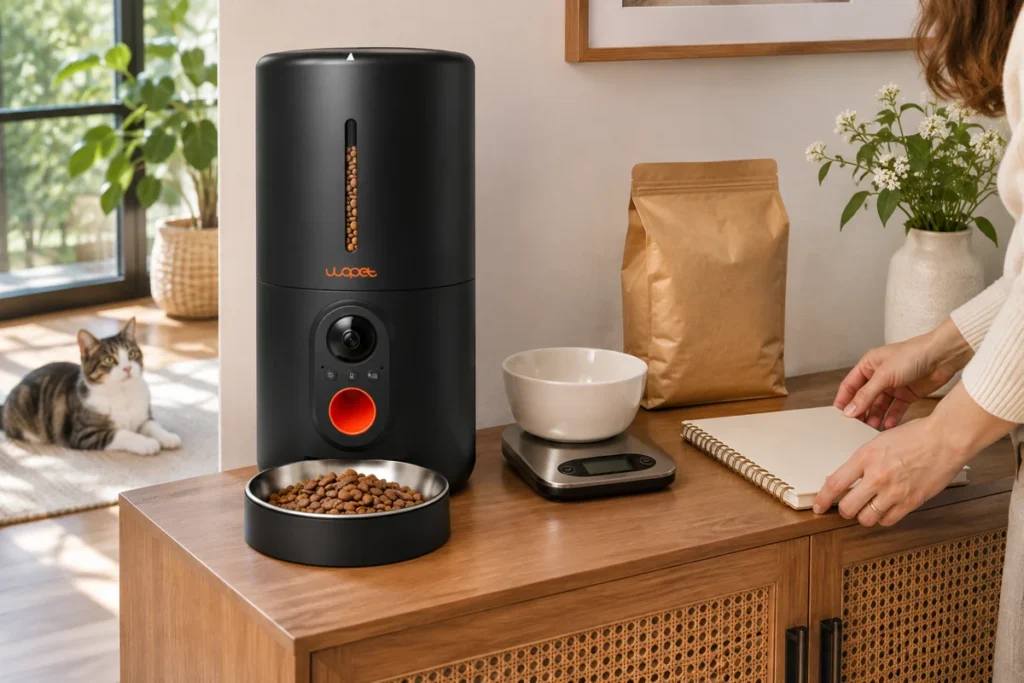
For households that want app scheduling and a camera in one unit, the WOPET HV10P is one option to compare. Its product page lists app scheduling, camera features, and backup battery support. Check the HV10P/HV10DP manual for setup details and model-specific limits before relying on any feature.
Plan for power, Wi-Fi, and household changes
If a model offers battery backup, confirm which batteries it requires, whether they are included, and what functions remain available during an outage. If it uses Wi-Fi, check that your home network meets the feeder’s requirements and place the unit where the signal is reliable. Our automatic feeder setup checklist can help you test the clock, schedule, and portions before the first unattended meal.
For a multi-pet home, consider whether another animal can reach the food or trigger the feeder. Separate feeding areas, supervision, or a different feeding setup may be needed. A dual-bowl product is not automatically the right choice for two dogs; check its intended use and whether each pet can eat comfortably without competition.
A practical checklist before you buy
- Does the feeder support the type and size of food your dog eats?
- Can you measure the actual output and set meals to match your dog’s plan?
- Is the bowl comfortable for your dog’s size and posture?
- Can you clean the removable food-contact parts easily?
- Do you understand the power, battery, and Wi-Fi requirements?
- Can you supervise your dog and provide care if the feeder stops working?
The best feeder is the one you can verify
An automatic feeder can make scheduled dry-food meals easier to manage, but it is still part of a care routine. If your dog eats canned food, check whether an automatic feeder can handle wet food. Test it with your dog’s food, observe several meals, keep a backup plan, and review changes in appetite or weight with your veterinarian. If you are comparing app and camera options, browse our automatic dog feeder collection and match each product’s manual to your needs.
Before comparing feeder settings, decide how you’ll split the daily ration and when someone can check the bowl. See how many meals to program on a dog feeder and how to build a consistent dog feeding routine.