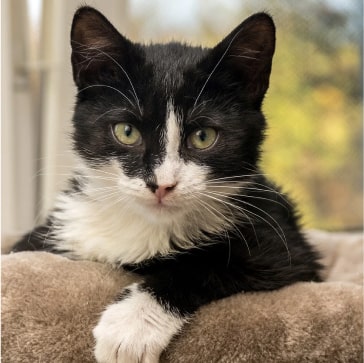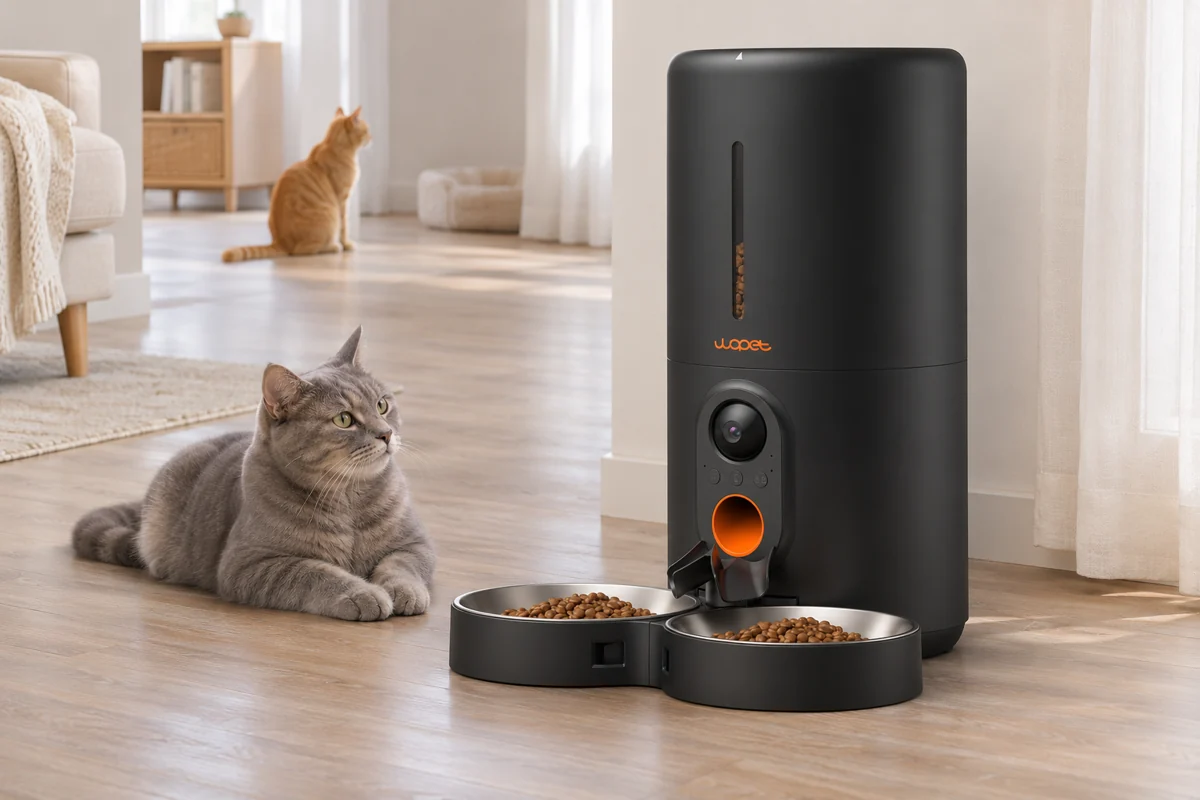

A dual-bowl feeder can work well for two cats that eat the same food and share a feeding area comfortably. If one cat steals food, needs a different diet or keeps the other away, separate feeding locations are usually a better starting point. A second bowl alone will not solve those problems.
Watch what happens after the first cat finishes eating. Does it leave, or move straight to the other bowl? That moment often tells you more about the setup you need than the number of bowls on the feeder.
Watch how your cats eat together
The feline feeding-program consensus statement recommends planning feeding locations around cats’ relationships and individual needs, including visually separated stations. Sharing a meal location is not proof that every cat is comfortable there. The Merck Veterinary Manual also recommends separate feeding stations to reduce competition in multi-pet homes.
Before buying, observe ordinary meals. Does one cat reach the food first every time? Does the other wait out of sight, stop eating when approached or leave food when the first cat returns? Use these observations to plan where each cat can eat comfortably. A new change in appetite or weight warrants a veterinary discussion.
One shared feeder or separate stations?
| Question | One feeder, two bowls | Separate feeding stations |
|---|---|---|
| Can two cats stand at different bowls? | Usually yes, within the station’s physical layout. | Yes, with more control over distance and sight lines. |
| Can each cat receive a different food? | Not from one shared hopper merely because there are two bowls. | Possible with separate food sources and an appropriate access plan. |
| Does it control which cat eats? | Not unless the exact model has documented identity-based access control. | Distance alone does not identify cats either; barriers or suitable access control may still be needed. |
| Does it guarantee equal grams per bowl? | No; check the documented assembly and weigh both outputs. | Each unit or served meal still needs its own portion check. |
| How much equipment needs care? | One main unit, with both bowls and permitted components to clean. | More separate equipment, but flexible placement and individual checks. |
When a dual-bowl unit may fit
Consider one when both cats can eat the same dry food, neither guards the station, and you can observe whether both reach their intended meals. Check their body positions at the bowls: they should not have to squeeze against furniture or block each other’s route away. Convenience for the owner is useful, but both cats must be able to use the arrangement.
One station can be simpler to refill and clean. Remember, though, that a shared hopper holds one food. Two bowls do not give you separate diets or control over which cat eats each serving.
When to choose separate locations instead
- One cat repeatedly blocks, follows or displaces the other at meals.
- The cats need different foods or tightly controlled individual amounts.
- One finishes quickly and routinely moves to the other bowl.
- A cat avoids the shared location even though it eats comfortably elsewhere.
Separate locations can use ordinary bowls or suitable automatic feeders. In some homes a closed-door meal or another planned barrier is more useful than adding another bowl beside the first. Two single-bowl feeders placed next to each other can still function as one shared feeding area. Choose distance, visual separation and access around the cats’ actual behavior.
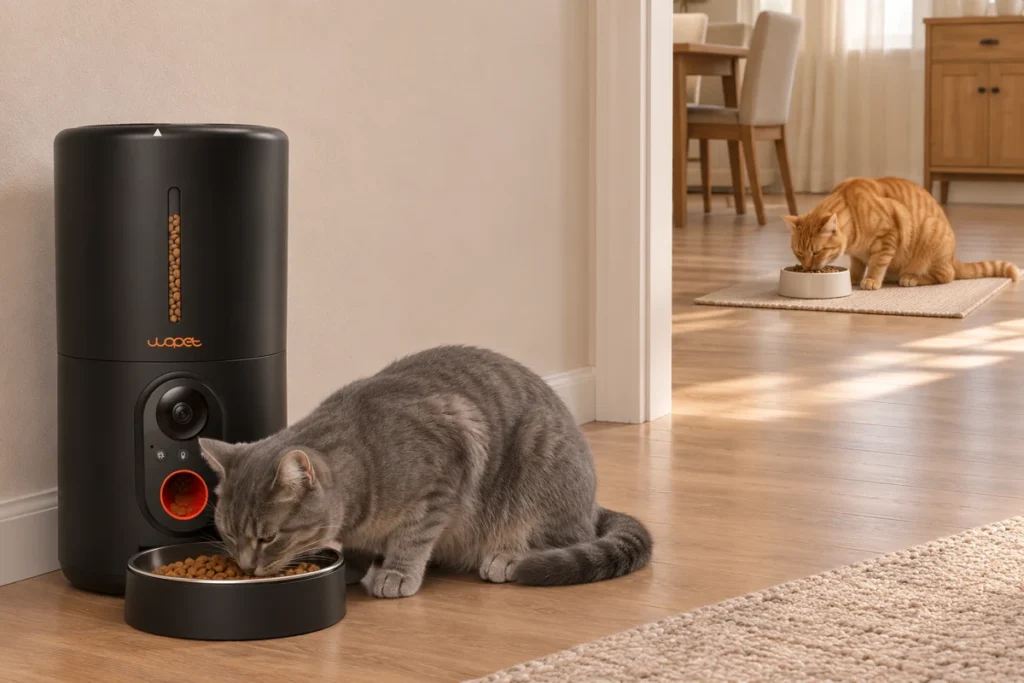
Check both bowls before relying on the feeder
1. Confirm the model and assembly. Read the exact manual for the bowl holder and any food-dividing component. Do not improvise a splitter or assume another model’s arrangement fits. Disconnect power before accessing parts the manual allows you to remove.
2. Weigh both bowl outputs without pets present. Use the intended food and meal setting. Measure the left and right outputs separately, then add them for the total. Repeat the check instead of judging equality by the apparent volume in each bowl. Use our feeder portion measurement guide for a repeatable method.
| Check | Left bowl (g) | Right bowl (g) | Total (g) | Assembly / setting notes |
|---|---|---|---|---|
| First complete dispense | Record | Record | Add both | Record |
| Repeat under same conditions | Record | Record | Add both | Record |
| Scheduled test meal | Record | Record | Add both | Record |
3. Observe a normal meal. Once safe delivery is verified, watch each cat approach, eat and leave. Note what happens when the faster eater finishes. A total-output measurement cannot tell you whether each cat received its own intended amount.
4. Keep a separate option ready. If either cat is repeatedly displaced or unable to reach food, change the arrangement instead of waiting for the cats to adapt to the equipment. Do not force them to share or reduce access to the alternative feeding location.
5. Recheck after changes. Changing kibble, moving furniture or adding a new pet can change how the setup works. Observe again after these changes, and arrange a person to check feeding when you are away.
WOPET examples: HV10P and HV10DP
| Model | Physical feeding layout | What to verify |
|---|---|---|
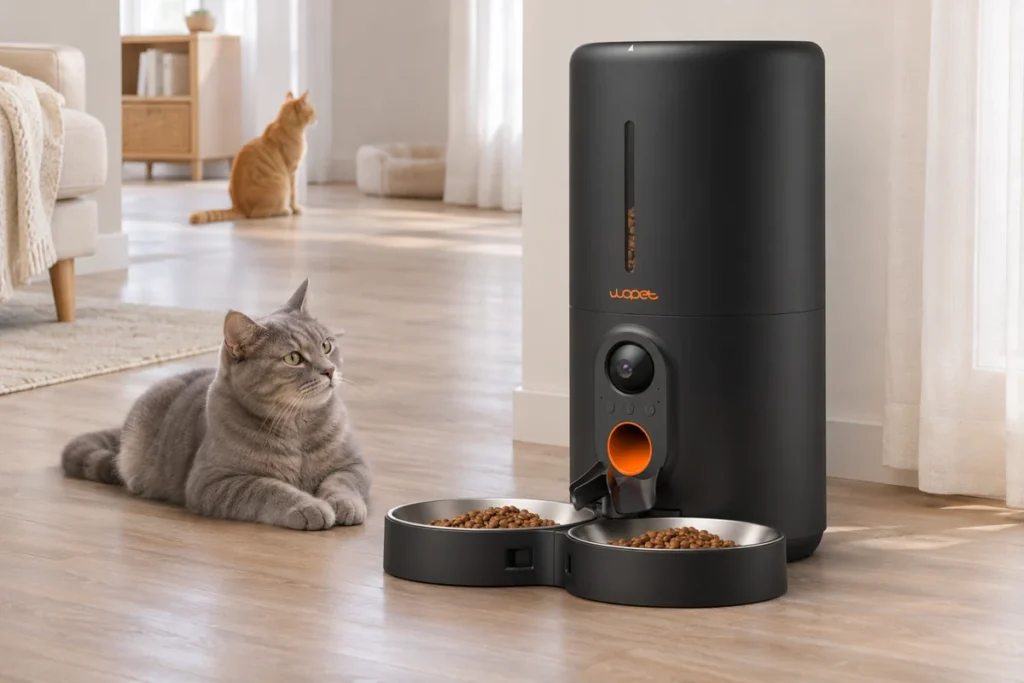
| HV10P | Single-bowl camera feeder. | The right location, measured delivery and who can reach the bowl. |
| HV10DP | Dual-bowl camera feeder. | Both bowl outputs, correct assembly and comfortable access for each cat. |
These model names are not interchangeable. Read HV10P support and operating manual or HV10DP support and manual before setup. A camera offers a view of events within its coverage; it does not weigh food, confirm every meal was eaten or turn an ordinary shared station into identity-controlled feeding.
Questions to settle before purchase
Can I put different foods in the two bowls? You can serve foods manually as appropriate, but a shared-hopper dispenser does not keep two foods separate simply because it has two bowls.
Will two bowls prevent food stealing? No. Think about access after dispensing and after one cat finishes. Separate feeding arrangements or suitable documented access-control features may be needed.
Is a dual feeder unsuitable for every two-cat home? No. The decision depends on compatible diets, the cats’ relationship, space and your ability to verify individual access. It should be selected for those conditions rather than the number of cats alone.
Before you buy
Choose the food plan and access arrangement first, then select the equipment, measure delivery and observe meals. Our automatic feeder guides and first-setup checklist cover the remaining setup checks.